If you have ever wondered how a lower-income country can make newer medicines that still look locked behind patents elsewhere, the answer often sits inside a specific WTO rule. In Bangladesh, the WTO LDC waiver generic medicine Bangladesh framework is the key reason local companies can legally manufacture certain patented medicines for the domestic market. This matters for patients, for public health systems, and for manufacturers building capacity responsibly. It also matters for accuracy, because the WTO LDC waiver generic medicine approach is real, but it is not a universal “permission slip” to export or sell everywhere.
To keep it simple, waiver generic medicine refers to how Least Developed Countries (LDCs) can apply WTO TRIPS transition provisions that delay certain intellectual property enforcement requirements, including pharmaceutical patents. In practice, waiver generic medicine Bangladesh can allow a country like Bangladesh to make and supply eligible generic medicines domestically without enforcing some pharmaceutical patent rights that would block that production in many high-income markets.
That is why WTO LDC waiver generic medicine comes up so often in conversations about access and affordability, and why it is important to separate what is legal to make in Bangladesh from what is legal to import in the US, EU, or other jurisdictions. Throughout this article, I’ll keep returning to the same anchor concept, the generic medicine pathway, because it is the legal foundation people tend to misunderstand.
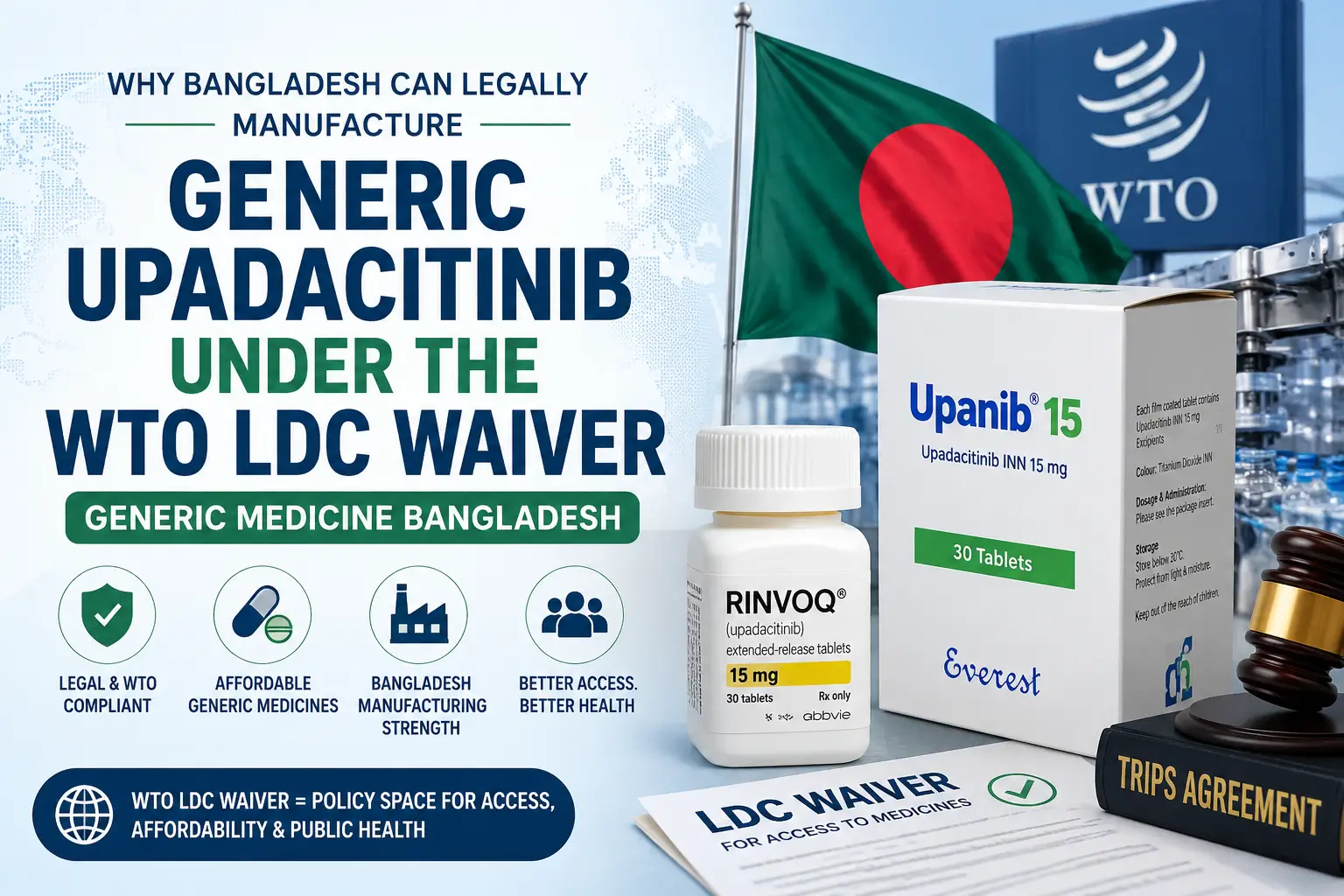
Now let’s apply this to a real example: Upanib (Upadacitinib), a medicine that is marketed as Rinvoq in many countries. Under the WTO LDC waiver generic medicine Bangladesh environment, Bangladesh can legally manufacture a domestic generic version in line with its local laws and the WTO transition rules, while Rinvoq may remain patent protected in the US and EU.
Table of Contents
The legal engine: TRIPS, LDC status, and the “waiver” people mean
When people say “WTO waiver,” they are often referring to transition arrangements under the WTO Agreement on Trade-Related Aspects of Intellectual Property Rights (TRIPS). TRIPS sets baseline standards for intellectual property protection across WTO members, including patents. But LDC members have been granted additional time to implement certain TRIPS obligati The WTO LDC Waiver is a crucial mechanism that allows Least Developed Countries (LDCs) like Bangladesh to access generic medicine without the stringent patent protections typically enforced under TRIPS.
By leveraging the WTO LDC Waiver, Bangladesh can enhance its capability to produce and distribute affordable generic medicines, ensuring that essential healthcare remains accessible to its population. This approach not only supports public health initiatives in Bangladesh but also aligns with the global commitment to improving health outcomes in LDCs. The WTO LDC Waiver thus plays a vital role in facilitating the availability of life-saving generic medicine, exemplifying how international trade agreements can be tailored to meet the unique needs of developing nations. ons.
For pharmaceuticals specifically, the WTO has repeatedly extended LDC transition periods, allowing LDCs to delay granting and enforcing pharmaceutical patents and related protections for a defined period. The WTO document trail on these extensions is public, and the logic is consistent: LDCs are given policy space to improve access to medicines and build industrial and regulatory capacity. This is the core of the WTO TRIPS waiver pharmaceuticals conversation and the practical basis for Bangladesh patent waiver drugs discussions. Sources that outline this framework include WTO materials on TRIPS transition periods for LDCs.
If that sounds abstract, here is the real world translation. Under the WTO LDC waiver generic medicine Bangladesh framework, Bangladesh can decide, within its national law, not to enforce certain pharmaceutical patent rights during the transition period. That is one reason Bangladesh’s local industry has become well known globally, and it directly connects to what many people search as Bangladesh generic drug manufacturing law.
Why Rinvoq can be patent-protected abroad while Bangladesh makes a generic
Upadacitinib is a small-molecule JAK inhibitor developed by AbbVie and sold as Rinvoq. Regulatory approval, patent rights, and marketing exclusivities differ by country. In the US and EU, Rinvoq remains subject to patent and regulatory exclusivity protections that can affect who can sell it, when, and under what conditions. The FDA’s Orange Book and EU regulatory and patent landscapes are part of this picture, but the practical point is straightforward: legal status in one country does not automatically carry over to another. (FDA Orange Book)
This is where many well-meaning explanations go wrong. The WTO LDC waiver generic medicine Bangladesh mechanism is about what Bangladesh may do under WTO rules and its own implementing laws. It does not erase patent rights in the US or EU, and it does not grant automatic permission to import a Bangladeshi generic into those markets.
So, when readers ask is Upanib legal or is Bangladesh generic medicine legal, the accurate answer depends on where and how. In Bangladesh, a generic like Upanib can be lawful to manufacture and supply under the WTO LDC waiver generic medicine Bangladesh framework and applicable national rules. In the US or EU, selling or importing may still be restricted by patents, exclusivities, and local regulatory approval requirements.
The other critical distinction: Manufacturing legality is not import approval
Even if a medicine is legally manufactured in Bangladesh under the WTO LDC waiver generic medicine Bangladesh pathway, that does not guarantee it can be shipped into another country and dispensed. Most countries require their own regulatory authorization, quality documentation, and supply-chain controls. Separate from those regulatory requirements, patents and exclusivities can independently restrict importation or sale.
This point matters because it protects patients from confusion. It is possible for all three statements to be true at once:
- Bangladesh can legally manufacture some generics under the WTO LDC waiver generic medicine Bangladesh transition rules.
- Rinvoq can remain patent protected in the US/EU.
- Importing a Bangladeshi-made generic into another market may still be unlawful or not permitted without local approvals.
This is also why careful language around Bangladesh patent waiver drugs is important. The waiver concept, in everyday use, is about a transition period that changes enforcement obligations for LDCs. It is not a global override.
How long does the LDC pharmaceutical transition last?
The WTO’s LDC pharmaceutical transition period has been extended multiple times. The current end date depends on the latest WTO decision in force, and these decisions can be further extended. The most reliable way to confirm the current timeline is to check WTO TRIPS Council decisions and official WTO releases.
For Bangladesh, the practical question is also about graduation from LDC status. When a country graduates from LDC classification, transition flexibilities may change over time, and national policy can evolve accordingly. So when people ask about the WTO TRIPS waiver pharmaceuticals timeline, the honest answer is that it is defined by WTO decisions and the country’s LDC status, and it should be confirmed from official WTO documentation.
Why Bangladesh’s generics are often cheaper, without the myths
People also ask, why is Bangladesh generic medicine cheap. The answer is not a single trick. It is usually a blend of lower manufacturing costs, scale efficiencies, local competition among manufacturers, and policy space created by the WTO LDC waiver generic medicine Bangladesh framework that reduces patent-related barriers for eligible products domestically. Lower prices can improve access, but it also makes quality systems and regulatory oversight even more important, because price alone should never be the proxy for safety or efficacy.
Quality and affordability can coexist, but they do not automatically do so. This is why verifying manufacturer compliance matters.
Where Ziska Pharmaceuticals fits in: Manufacturing capacity and cGMP focus
Bangladesh has many pharmaceutical manufacturers, and one name that is often discussed in this context is Ziska Pharmaceuticals Ltd. If you are researching an Upanib manufacturer Ziska Pharmaceuticals connection, the most responsible approach is to evaluate manufacturing standards, facility compliance claims, and any published certifications or regulatory inspection outcomes available from the company or relevant authorities.
cGMP, shorthand for current Good Manufacturing Practice, is a baseline set of quality systems expected for consistent manufacturing. cGMP alignment does not mean a product is approved in every country, but it is part of what patients and procurement teams look for when assessing manufacturing credibility. If Ziska presents itself as cGMP compliant, you should still verify that through their official documentation and any accessible compliance or quality pages.
This is also where the WTO LDC waiver generic medicine Bangladesh discussion becomes practical, not theoretical. The waiver can create legal room to manufacture domestically, but trust is built through transparency: quality systems, batch testing, pharmacovigilance, and traceable distribution. If Upanib is manufactured under Bangladesh’s legal framework, patients still deserve clear, verifiable information on quality practices and proper medical supervision in use. Mentioning Upanib here is intentional because people search both the molecule and the brand-like generic name, but the standards that matter are the same.
A small reality check on what “legal” should mean for patients
When someone searches is Bangladesh generic medicine legal, they are often not only asking about patents. They are really asking, “Is it legitimate and safe?” Patents are legal tools. Safety is a clinical and regulatory outcome.
Upadacitinib has specific risks and monitoring considerations described in FDA labeling for Rinvoq, including serious infections and other warnings that clinicians weigh against benefits based on the patient’s condition. Any version, including a generic like Upanib, should be used only under qualified medical guidance.
So yes, is Upanib legal can be answered at the patent and manufacturing level using the WTO LDC waiver generic medicine Bangladesh lens. But patient-first decision-making still requires the prescribing clinician, the approved indication in the relevant country, and a product sourced through lawful, regulated channels.
What to do next: Verify credentials before you trust a label
If you are evaluating a Bangladeshi manufacturer or trying to understand whether a product is made under the WTO LDC waiver generic medicine Bangladesh environment, your next steps should be evidence-based. At minimum, look for official manufacturer documentation and compliance statements that you can verify directly.
For Ziska Pharmaceuticals Ltd., use these as your practical calls to action:
- Visit the manufacturer’s official website and review their company profile, manufacturing facility, QA/QC systems, and cGMP statements.
- Check the manufacturer’s compliance, certifications, and credentials pages and save copies for procurement documentation.
If you are considering Upanib specifically, ask for the product’s batch documentation, quality testing summaries where available, and distribution legality for your country. Upanib may be manufactured legally in Bangladesh under the WTO LDC waiver generic medicine Bangladesh framework, but you still need to confirm whether your jurisdiction permits importation, sale, or personal use.
In the end, I think the most balanced way to view the WTO LDC waiver generic medicine Bangladesh system is this: it is a policy tool designed to expand access and build capacity, but it works best when it is paired with transparent manufacturing standards and clear, country-by-country regulatory boundaries. That mix of law, science, and restraint is not always satisfying, but it is the honest path.
And maybe that is the philosophical lesson here. Access to medicine is not just a question of what we can make, but what we can stand behind.