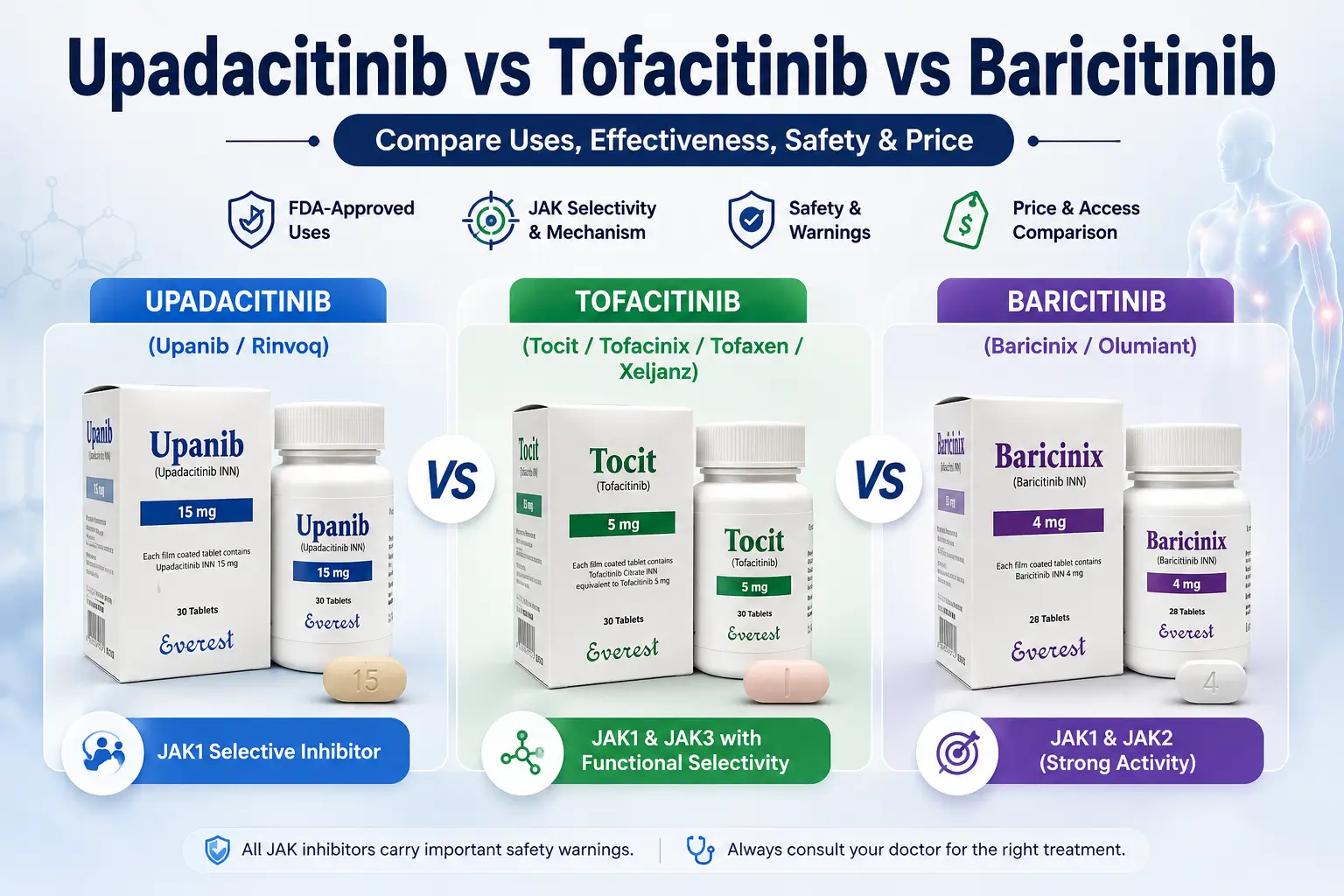
If you’re trying to make sense of upadacitinib vs tofacitinib vs baricitinib, you’re not alone. People usually start with one simple question, “Which one fits my condition, my risk factors, and my budget?” This guide is a patient-first JAK inhibitor comparison of upadacitinib vs tofacitinib vs baricitinib, including how these medicines work, where the FDA says they can be used, and a practical JAK inhibitor price comparison (including typical US brand pricing and “Emergency Drug” pricing as listed by your requested format). I’ll also compare Rinvoq vs Xeljanz vs Olumiant in plain English, because that’s the real-world version of upadacitinib vs tofacitinib vs baricitinib most people recognize.
Before we get into the details, one important framing point: there isn’t a single “winner” in upadacitinib vs tofacitinib vs baricitinib. The “best” option depends on the condition being treated, previous treatments, age and cardiovascular risk, infection history, other meds, pregnancy plans, and what your prescriber is watching in your labs.
Table of Contents
How JAK inhibitors work (simple explanation)
JAK inhibitors are oral medicines that quiet down specific parts of the immune signaling system. “JAK” stands for Janus kinase, a family of enzymes involved in sending inflammatory messages inside cells. When those messages stay too loud for too long, inflammation can drive symptoms in autoimmune diseases like rheumatoid arthritis, psoriatic arthritis, ulcerative colitis, and more.
In the upadacitinib vs tofacitinib vs baricitinib discussion, a key theme is selectivity. Some JAK inhibitors are more “JAK1 leaning” (often described as a JAK1 selective inhibitor), while others inhibit multiple JAK pathways. Selectivity is not a guarantee of better safety or effectiveness for any one person, but it is part of what your clinician considers when doing a JAK inhibitor comparison.
Sources: FDA labels for RINVOQ (upadacitinib), XELJANZ (tofacitinib), OLUMIANT (baricitinib).
Comparison table
The table below is meant to support a quick JAK inhibitor price comparison alongside the clinical basics of upadacitinib vs tofacitinib vs baricitinib. Approved uses are summarized at a high level; always confirm the exact indication, age range, and dosing details in the FDA label.
| Drug | Active ingredient | JAK selectivity (label/commonly described) | FDA-approved uses (examples) | US brand price* | Emergency Drug price* | Product |
| Rinvoq | Upadacitinib | Commonly described as JAK1 selective inhibitor | RA, PsA, AS, nr-axSpA, UC, Crohn’s, atopic dermatitis, others (see label) | Varies by pharmacy/plan | Varies by supplier | Upanib (Upadacitinib) |
| Xeljanz | Tofacitinib | JAK1/JAK3 (less selective overall) | RA, PsA, UC, others (see label) | Varies by pharmacy/plan | Varies by supplier | Tofacitinib products below |
| Olumiant | Baricitinib | JAK1/JAK2 | RA, alopecia areata, others (see label) | Varies by pharmacy/plan | Varies by supplier | Baricitinib product below |
*Pricing changes frequently and depends on dose, quantity, pharmacy, and insurance. Use this as a comparison framework, not a quote.
Key FDA-label differences that matter in real life
When people search upadacitinib vs tofacitinib vs baricitinib, they often want a clean verdict. The FDA labels do not rank one as “best,” but they do give clear differences in approved uses, boxed warnings, monitoring, and drug interactions.
1) Approved uses are not identical
A major difference in upadacitinib vs tofacitinib vs baricitinib is simply whether your condition is on-label. For example, upadacitinib (RINVOQ) has multiple inflammatory indications including rheumatoid arthritis and several spondyloarthritis conditions, and inflammatory bowel disease indications (UC and Crohn’s) on its label. Tofacitinib (XELJANZ) includes RA, PsA, and UC. Baricitinib (OLUMIANT) includes RA and alopecia areata among its labeled uses.
That’s why the “best JAK inhibitor for rheumatoid arthritis” question is usually less about RA itself and more about your personal risk profile, prior biologic response, dosing needs, and what your rheumatologist is aiming for.
2) Boxed warnings and serious risks are a class conversation
In the Rinvoq vs Xeljanz vs Olumiant comparison, you will see prominent safety warnings in FDA labeling, including serious infections, malignancy, major adverse cardiovascular events (MACE), thrombosis, and mortality risk language. Your clinician weighs these risks against expected benefits and against alternatives like TNF blockers or other biologics, especially in older adults and people with cardiovascular risk factors.
This is one reason upadacitinib vs tofacitinib vs baricitinib should not be a self-serve decision. The “right” choice is the one your prescriber can justify for your situation and monitor appropriately.
3) Monitoring and interactions differ in the details
All three can require lab monitoring (for example, blood counts and lipids) and screening for infection risk (like TB) as described in labeling. Specific interaction cautions vary, and dosing may change with kidney or liver impairment depending on the product and indication. In a practical JAK inhibitor comparison, these operational details sometimes decide the prescription more than headline selectivity.
Which is “best” in upadacitinib vs tofacitinib vs baricitinib?
Here’s the most honest answer: upadacitinib vs tofacitinib vs baricitinib is not a quiz with one correct option. It’s more like choosing the right key for the right lock, and the lock is your diagnosis, comorbidities, past medication history, lab trends, and tolerance for risk.
If you’re discussing upadacitinib vs tofacitinib vs baricitinib with a specialist, these are often the deciding themes: on-label indication match, prior biologic/JAK response, cardiovascular and clot risk factors, infection history, kidney function, other medications, pregnancy considerations, and access or affordability (the unglamorous part of every JAK inhibitor price comparison).
Talk to a prescribing clinician before switching or starting
Even if you feel strongly after reading a JAK inhibitor comparison, the safest next step is a targeted conversation with your prescriber. Ask them to explain why they prefer one option in upadacitinib vs tofacitinib vs baricitinib for you, and what they plan to monitor over time.
A quick recap
When you boil upadacitinib vs tofacitinib vs baricitinib down to what patients actually feel, it often comes to two things: “Will it help me function better?” and “What is the safest reasonable option for me long term?” Labels provide the guardrails, but the art is in the matching.
If you want a grounded next step, treat this like a collaborative decision. Bring your concerns, your budget realities, and your treatment goals into the appointment. Then let your prescriber do what they are trained to do: translate population-level FDA information into an individual plan. In the end, that’s the quiet lesson behind every JAK inhibitor comparison. Medicine is powerful, but it is also personal.
Disclaimer: This article is for informational purposes only and does not constitute medical advice. Always consult a qualified healthcare professional before starting, stopping, or changing any medication.
FAQs
1) Is upadacitinib vs tofacitinib vs baricitinib mainly about “which is strongest”?
Ans: Not exactly. FDA labels don’t call one strongest. The choice depends on your diagnosis, prior treatment response, safety risks, and monitoring needs your clinician can support over time.
2) In Rinvoq vs Xeljanz vs Olumiant, does JAK selectivity guarantee fewer side effects?
Ans: No. “JAK1 selective inhibitor” language can be helpful context, but FDA labeling emphasizes serious risks across the class. Your personal risk factors matter more than selectivity alone.
3) What should I ask my doctor when discussing upadacitinib vs tofacitinib vs baricitinib?
Ans: Ask which FDA-approved indication applies to you, what labs and infection screening are required, how dosing works for your health conditions, and what symptoms should trigger urgent medical evaluation.
4) How should I think about JAK inhibitor price comparison in the real world?
Ans: Start with your exact dose and quantity, then compare insurance coverage, prior authorization rules, and pharmacy pricing. Brand list prices can mislead; your net cost may differ substantially.
5) Is there a best JAK inhibitor for rheumatoid arthritis for everyone?
Ans: No single best option exists for everyone with RA. The best choice balances symptom control, safety, convenience, and affordability, using FDA-label information and your clinician’s judgment together.