Table of Contents
Rinvoq Boxed Warning Explained: Infection, Cancer, and Blood Clot Risk
If you are here because you saw the black box on the label and felt your stomach drop, you are not alone. Rinvoq boxed warning explained is one of those searches people make at night, right after a new prescription, when the questions start coming faster than the answers. This guide walks through what the FDA is actually warning about for upadacitinib, what risks tend to matter most for real people, and how to have a calmer, more productive conversation with your clinician before you start.
Upanib (Upadacitinib) is a prescription JAK inhibitor. The FDA requires a Boxed Warning for this class because, while these medicines can reduce inflammation meaningfully, they can also change how your immune system and blood vessels behave. So, in plain language, Rinvoq boxed warning explained really means: know the major risks up front, know your personal risk factors, and monitor the labs that can signal trouble early. Sources for the medical claims below are the FDA prescribing information and related FDA safety communications, plus peer-reviewed literature on JAK inhibitors.
The “why” behind the Boxed Warning
A Boxed Warning is the FDA’s strongest label warning. It exists to highlight risks that can be serious, life-threatening, or preventable with good screening and monitoring. When people ask, “Rinvoq boxed warning explained in one sentence?” I usually frame it like this: upadacitinib can raise the risk of serious infections, certain cancers, major heart-related events, and blood clots, especially in people with specific risk factors. That is the whole point of reading the warning, not to scare you, but to help you personalize the decision.
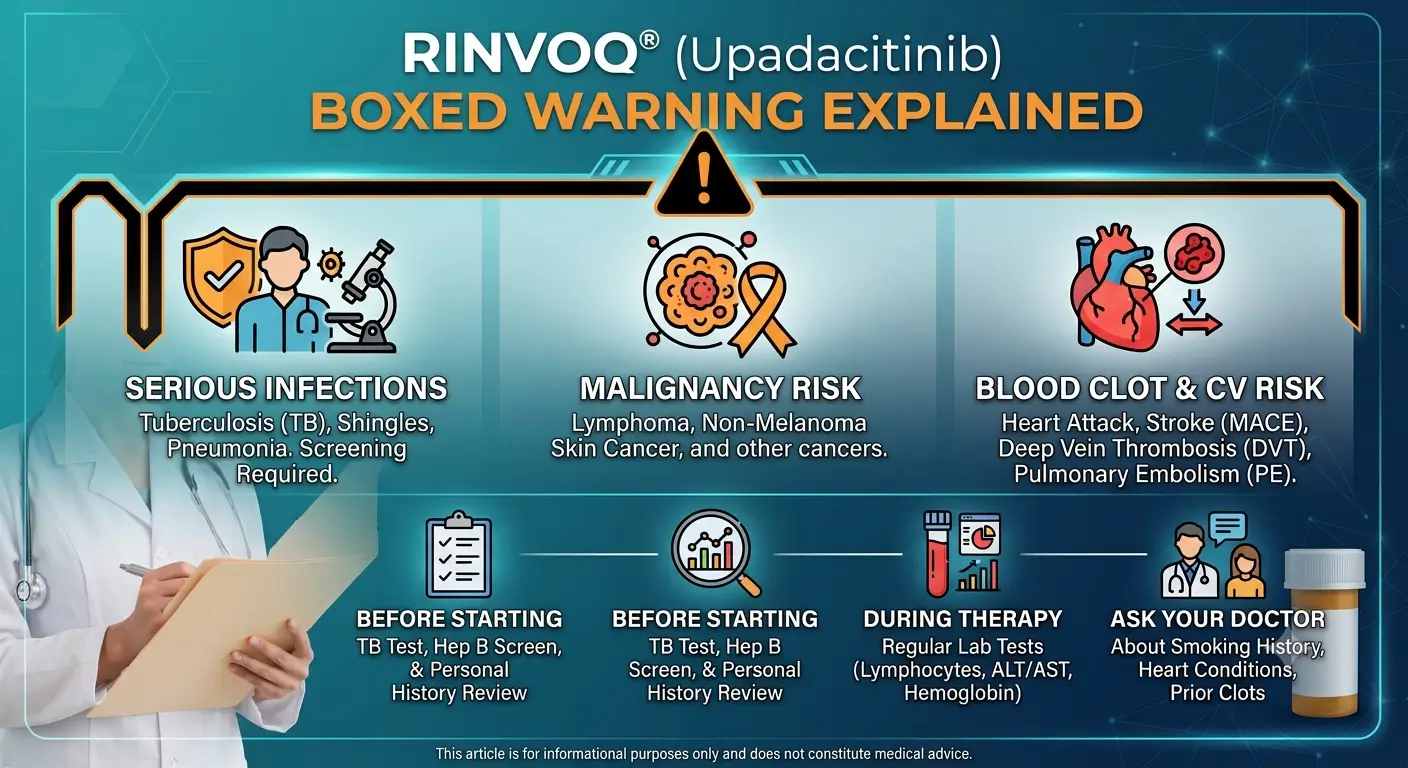
The FDA’s upadacitinib prescribing information lists these risks in the Boxed Warning: serious infections (including tuberculosis), malignancy, major adverse cardiovascular events (MACE), and thrombosis. It also emphasizes that these risks are seen with JAK inhibitors, and careful patient selection matters. (Source: FDA Prescribing Information for RINVOQ/upadacitinib.)
1) Serious infections: The most immediate risk to understand
When you see Rinvoq boxed warning explained, infections are usually the first section, for good reason. Upadacitinib reduces immune signaling. That is part of how it calms autoimmune inflammation, but it can also reduce your ability to fight certain infections.
The FDA warns about serious bacterial, fungal, viral, and opportunistic infections, including infections that lead to hospitalization or death. It also highlights risks like pneumonia and shingles, and notes that serious infections have occurred in people receiving JAK inhibitors. (Source: FDA Prescribing Information.)
In day-to-day terms, this is the risk that may show up earliest if it shows up at all. People often ask about upadacitinib side effects serious enough to stop treatment. With infections, the key is that early symptoms can look ordinary at first. Fever, shortness of breath, a persistent cough, painful rash, severe fatigue, or a wound that is not healing are not “wait and see for two weeks” symptoms on a JAK inhibitor. They are “call your doctor” symptoms.
Tuberculosis (TB) reactivation and screening
The FDA specifically warns about active TB and reactivation of latent TB. That is why TB testing is required before starting, and why ongoing monitoring may be needed during treatment. If you have lived in or traveled to areas where TB is more common, or have had close contact with someone with TB, say that out loud to your clinician, even if it feels like ancient history. (Source: FDA Prescribing Information.)
This is one of those places where Rinvoq boxed warning explained is really about process. A large chunk of risk reduction comes from screening and acting on results before the first pill.
2) Malignancy (cancer): What the warning means, and what patients should ask
The Boxed Warning includes malignancy, including lymphoma and other cancers, and it also mentions non-melanoma skin cancers. When people search Rinvoq boxed warning explained, the cancer section is often the most emotionally loaded, because it is hard to weigh an invisible future risk against a very real current disease.
The FDA’s warning does not mean everyone will get cancer. It means the risk is serious enough, in the context of this mechanism, that it must be clearly highlighted and discussed. A practical way to approach Rinvoq cancer risk warning is to ask: “Do I have risk factors that meaningfully shift the risk-benefit balance?”
Talk to your doctor if you have a history of cancer, a strong family history, significant sun exposure, prior phototherapy, or prior immunosuppressive treatment. Skin exams may be recommended, especially if you are higher risk. (Source: FDA Prescribing Information.)
This is also where patient-first nuance matters: some inflammatory diseases themselves are associated with higher baseline risks, and some alternative therapies carry their own warnings. Rinvoq boxed warning explained is not “Rinvoq is dangerous” so much as “Rinvoq requires an adult conversation about tradeoffs.”
3) MACE: The cardiovascular risk conversation many people skip (but should not)
The Boxed Warning includes major adverse cardiovascular events (MACE), which can include heart attack and stroke. If you have ever wondered about JAK inhibitor cardiovascular risk, this is the headline: the FDA wants clinicians and patients to take cardiovascular history seriously when considering therapy.
In a clinic visit, this part can feel abstract, so bring it down to specifics. Your risk profile matters more than generic reassurance. Talk to your doctor if you have high blood pressure, diabetes, high cholesterol, obesity, chronic kidney disease, a prior heart attack or stroke, or a strong family history of early cardiovascular disease. Smoking status matters a lot here, and the FDA specifically notes higher risk in current or past smokers for certain serious outcomes with JAK inhibitors.
If you are asking yourself, is upadacitinib safe for me personally, this is one of the most important sections to personalize. For some patients, controlling inflammation can improve overall health and function. For others, a different medication may be a better fit, especially if cardiovascular risk is already high. That is a decision your prescriber should walk through with you, not around you.
4) Thrombosis (blood clots): What “Rinvoq blood clot risk” looks like in real life
The Boxed Warning also includes thrombosis, meaning blood clots in veins or arteries, such as deep vein thrombosis (DVT) and pulmonary embolism (PE). Patients often search Rinvoq boxed warning explained after hearing “blood clots” because it is both scary and unfamiliar.
A practical way to understand Rinvoq blood clot risk is to know the warning signs and your personal risk factors. Symptoms that deserve urgent medical attention include swelling, pain, or tenderness in a leg; sudden shortness of breath; chest pain that worsens with breathing; or coughing up blood. The FDA labeling advises discontinuation in patients with symptoms of thrombosis and prompt evaluation.
Talk to your doctor if you have had a prior clot, known clotting disorder, prolonged immobility, major surgery planned, estrogen therapy, active cancer, or other factors that increase clot risk. This is not a place for guesswork. It is a place for a clear, documented plan.
Risk-factor checklist: How to turn the Boxed Warning into a useful conversation
By now, Rinvoq boxed warning explained should feel less like a scary paragraph and more like a set of checkpoints. The FDA labeling repeatedly comes back to a simple theme: risks increase in certain groups, so identify those groups early.
Here are the risk factors worth saying explicitly to your clinician, even if they are already in your chart:
- Current or past smoking history
- Prior heart attack, stroke, angina, heart failure, or known atherosclerotic disease
- Prior blood clot (DVT/PE) or strong clot history in first-degree relatives
- History of cancer or high-risk skin cancer history
- Recurrent infections, chronic lung disease, diabetes, or conditions that increase infection risk
- Known exposure risk for TB, or prior positive TB test
This is the “framework” moment: Rinvoq risks are not one-size-fits-all. The same label can translate to different choices depending on who you are and what you have tried already.
Monitoring: The labs the FDA expects you to watch
A big part of Rinvoq boxed warning explained is understanding that monitoring is not optional paperwork. It is how clinicians catch predictable problems early, before they become emergencies.
The FDA prescribing information recommends evaluating baseline labs and monitoring during therapy, including:
- Lymphocytes (absolute lymphocyte count)
- ANC (absolute neutrophil count)
- Hemoglobin
- Liver enzymes (for example, ALT and AST)
These labs matter because decreases in blood counts can increase infection risk, and liver enzyme elevations can signal liver irritation or injury. The label includes guidance on when not to start treatment and when to interrupt dosing based on lab abnormalities. (Source: FDA Prescribing Information.)
If you are the kind of person who likes clarity, ask your clinic two simple questions: “What is my baseline?” and “At what number do you pause or stop the medication?” When patients understand the plan, adherence and safety both improve.
Contraindications and consistency: Why your blog and product page should match
One subtle but important patient-safety point is consistency. If your blog says one thing and your product page says another, it creates confusion, and confusion is where medication mistakes live.
So, if you maintain a blog post titled Rinvoq boxed warning explained, make sure the related product or information pages use the same FDA-aligned risk language. Do not soften or omit the big categories: serious infections and TB, malignancy, MACE, and thrombosis. Also keep contraindications and key precautions consistent with the current FDA prescribing information for upadacitinib.
This also applies to terminology. If you mention Upanib side effects warning content in one place, do not hide it in another. Patients notice mismatches, and it erodes trust fast.
Where Upanib fits in the real world
It is normal to read Rinvoq boxed warning explained and wonder if you should walk away from the prescription entirely. Sometimes that is the right choice. Other times, the better choice is to slow down, do the screening correctly, adjust other risk factors you can control, and proceed with monitoring.
Upanib can be a reasonable option for some patients when other therapies have not worked well or are not appropriate, but it should be started with eyes open. If you smoke, treating that as a medical priority is not moralizing, it is risk reduction. If your blood pressure is uncontrolled, fix that first. If you have a history of cancer, insist on a coordinated plan that includes the right specialists. This is what “patient-centered” looks like.
If you want a practical next step, consider reviewing your clinician’s instructions on dosing, lab schedules, and when to hold the medication, then compare that with the FDA labeling language. A soft place to continue is a dedicated page that explains dosage and monitoring details in plain English, including the lab plan and symptom checklist, rather than anything about pricing.
In the end, Rinvoq boxed warning explained is really about learning how to live with uncertainty in a disciplined way. Modern medicine gives us powerful tools, but it cannot remove all risk. What it can do is make risk discussable, measurable, and, sometimes, avoidable. There is something quietly human in that: we do not get perfect certainty, but we can get better questions, and better questions tend to lead to better outcomes.
FAQs
1) What does “Rinvoq boxed warning explained” actually cover in everyday terms?
Ans: Rinvoq boxed warning explained focuses on the FDA’s most serious risks: serious infections including TB, certain cancers, major cardiovascular events like heart attack or stroke, and dangerous blood clots requiring urgent evaluation.
2) Who should be extra cautious about JAK inhibitor cardiovascular risk?
Ans: People with prior heart disease, stroke, high blood pressure, diabetes, high cholesterol, obesity, kidney disease, or current or past smoking should discuss JAK inhibitor cardiovascular risk carefully with their clinician before starting.
3) What symptoms could suggest Rinvoq blood clot risk and need urgent care?
Ans: Seek urgent care for sudden shortness of breath, chest pain with breathing, coughing blood, or one-sided leg swelling and pain. These can signal Rinvoq blood clot risk like DVT or pulmonary embolism.
4) How do doctors monitor upadacitinib side effects serious enough to pause treatment?
Ans: Clinicians monitor lymphocytes, ANC, hemoglobin, and liver enzymes before and during therapy. Abnormal results can increase infection risk or signal liver issues, guiding dose interruption per FDA labeling.
5) Is upadacitinib safe if I had cancer or frequent infections in the past?
Ans: Is upadacitinib safe depends on your history. Prior cancer, recurrent infections, TB risk, and smoking can shift benefits and risks. Bring your full history so your doctor can individualize screening and monitoring.